
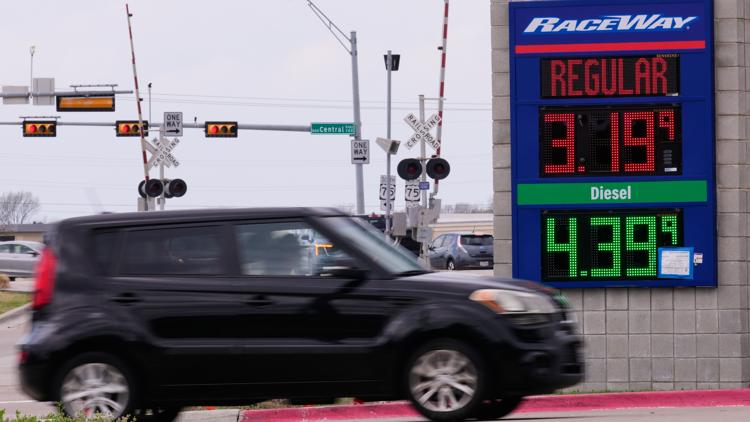
The average cost of a gallon of gas has jumped more than 30 cents in the last week, as the U.S. conflict with Iran disrupts the global flow of oil.
WASHINGTON — Gas prices are continuing to rise across the nation, in what is becoming a worrying trend for motorist as the U.S. conflict with Iran impacts oil prices.
As of Friday, the average cost of a gallon of gas was $3.32 in the U.S., according to AAA, which tracks gas prices in all 50 states and D.C.
That’s a seven cent jump from Thursday, and a 33-cent increase from the average gas price a week ago, before the initial U.S. strikes against Iran began hitting the oil markets.
The cost of oil is rising partly because of Iran’s stranglehold on tanker movement through the Straight of Hormuz, the narrow mouth of the Persian Gulf through which about a fifth of the world’s oil is shipped.
The strait is governed by international law, but Iran has significant control over the waterway. The strait has never been closed before, though shipping was disrupted in the 1980s.
However, Iran has recently attacked several ships in the Strait of Hormuz and threatened any ships that try to pass through, effectively closing it.
“The Strait of Hormuz is closed,” declared Iranian Brig. Gen. Ebrahim Jabbari, an adviser to the paramilitary Revolutionary Guard, threatened to set fire to any ships attempting to transit. “Don’t come to this region.”
Crude oil prices are the driving factor for the cost of gasoline, with higher prices per barrel directly tying to consumers paying more at the pump. According to the federal government, there’s a general rule that for every $1 change in the price of oil, there’s roughly a 2.4-cent change per gallon of gas.
The price for a barrel of benchmark U.S. crude rose above $90 for the first time in more than two years on Friday as the conflict in Iran spreads. The increase is having wider effects through the economy, including in the stock market.
A barrel of crude in the U.S. last crossed the $90 mark in October 2023.
Analysts, however, aren’t terribly worried yet. The U.S. market has a history of shaking off military conflicts in the Middle East relatively quickly, though that comes with a caveat that oil prices don’t jump too high.
The Associated Press contributed to this report.
About the Author


