Think ‘Sesame Street’ but with death, depression, and existential dread. At first glance, it looks like any other children’s cartoon: Round, brightly colored animals teaching kids to share, be polite, and cross the street safely. But Russia’s most beloved animated series, ‘Smeshariki’ – released internationally as ‘KikoRiki’ and in the US as ‘GoGoRiki’ or ‘BalloonToons’ – hides something stranger.
Beneath the cheerful surface lies a world of heart attacks, suicide jokes, and meditations on the meaning of life. In Russia, a country where fairy tales have never shied away from darkness, it’s no wonder this cartoon became both a cultural phenomenon and an internet cult.
The birth of Russia’s ‘two-level’ cartoons
Soviet animators worked under conditions that would have killed off most creative industries: Bad equipment, tiny budgets, and a censor breathing down their necks. The idea of ‘adult animation’ didn’t exist in the USSR, but animators still found ways to keep parents entertained. They slipped in jokes about bureaucrats and social misfits – you can spot them in the Soviet ‘Winnie the Pooh’ or in ‘The Adventures of Captain Vrungel’. Others went darker, with unsettling works like ‘Hercules at Admet’s’.
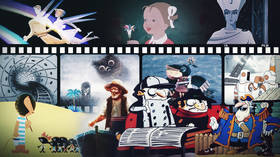
Out of this came a whole subgenre sometimes described as ‘psychedelic Soviet fairy tales’. These weren’t just bedtime stories with pretty colors. They mixed surreal imagery, absurd humor, and hints of political satire – odd little films that could mesmerize kids while giving adults a completely different experience. Titles like ‘Wow! A Talking Fish!’ still feel strange and hypnotic today.
The point was never to create a double audience on purpose. It was survival. When you can’t openly critique society, you hide commentary in a cartoon about animals, wizards, or a talking fish. That habit – speaking to children and adults at once – became second nature to Russian animation.
A cartoon with no villains
Smeshariki – a mash-up of the Russian words for ‘laughter’ (smekh) and ‘little balls’ (shariki) – premiered in 2004 and quickly became a national hit. It ran for nearly a decade, spawned three feature films, an educational spin-off called ‘Pincode’, and even a movie-within-a-movie anthology. The franchise bled into video games, public-service ads, and piles of merchandise. Internationally, it reached 23 countries, including the US.
On the surface, the characters look like any others: A bouncy rabbit named Krosh, his anxious hedgehog sidekick Yozhik, the dreamy poet-sheep Barash, and others.
Nyusha – a capricious and ambitious pig
Sovunya – a strict, health-obsessed owl
Kar-Karych – an aging crow with artistic pretensions
Pin – an eccentric inventor penguin with a thick German accent
Kopatych – a no-nonsense farmer bear with a southern Russian twang
Losyash – an active moose professor
They live in Flower Valley, a self-contained world with no villains, no battles, and no real outside contact.
That lack of villains is crucial. Every conflict comes from the characters’ own flaws or mistakes, not from some evil force. The episodes almost always reset to a cheerful status quo – yet more than once, the stories veer into territory that’s unnervingly heavy for a preschool cartoon.
When the cartoon turns dark
At its most unsettling, Smeshariki feels less like a children’s cartoon and more like a fragment of Russian literature. Behind the cheerful colors unfold stories about death, loss, and the absurdity of existence.
Take Pin, the eccentric penguin inventor. In ‘Close to Heart’, he works himself into such an emotional frenzy that he suffers a heart attack. He tries to numb his feelings to avoid another one, only to collapse again. Temporarily paralyzed, he sits helplessly as his poetic friend Barash – who, in the same episode, has been abducted by aliens – dances in front of him. It’s a surreal, almost nightmarish sequence about fragility, helplessness, and the limits of control.
Or consider ‘The Magic Pot’. Yozhik, the timid hedgehog, wanders the forest at night, marveling at glowing fireflies. One flickers weakly, its light fading for good. Desperate, Yozhik seeks help, but the moose professor Losyash explains that nothing can be done: The light is gone forever. Only Barash can help, by carrying the firefly into his magic pot, a world of imagination where it still shines. The episode was dedicated to one of the show’s own creators, who died during production – a hidden memorial disguised as a bedtime story.
Then there is ‘The Meaning of Life’, one of the bleakest half-hours ever slipped into a children’s cartoon. Barash sinks into existential despair. “What’s the point of washing up in the morning? To feel awake. But what’s the point of being awake?” he asks. His search for meaning leads him on a perilous journey toward a mystical figure named Kuzinatra. Though he never reaches her, Barash concludes that the value lies not in arriving, but in paving the way for those who will follow. After narrowly escaping death, he accepts life’s absurdity with a kind of weary peace.
And those are only the highlights. Across its run, Smeshariki quietly touches on themes far removed from playground morality:
-
Identity (Butterfly)
-
Addiction (That Sweet Word ‘Honey’)
-
Prostitution (Mountains and Candy)
-
Internet dependency (Telegraph)
-
Propaganda (Truffle)
-
Suicide (Valhalla)
Layered over all this are sly nods to cinema both Russian and global – ‘Stalker’, ‘The Matrix’, ‘Terminator’, ‘Forrest Gump’, ‘Night of the Living Dead’, even Hitchcock’s ‘Psycho’.
To children, these are just curious adventures. To adults, they read like allegories of workaholism, escapism, and death – a philosophical undercurrent running beneath the cheerful colors and round little animals. It’s unsettling, fascinating, and impossible to ignore.
From bedtime TV to internet cult
For children, the unsettling storylines pass by as just another quirky adventure. The bright colors and slapstick humor soften the blow, and most kids never notice the philosophical undertones.
Adults, however, have turned Smeshariki into a phenomenon of its own. Online forums are full of lengthy essays unpacking the hidden meanings of particular episodes – whether they’re allegories of workaholism, grief, or existential futility. At the same time, the show has spawned a thriving meme culture, where its round, bouncy characters get pasted into bleak jokes about depression, burnout, and politics.
What makes this dual reception even stranger is the stance of the creators. Officially, Smeshariki remains labeled as children’s programming. It airs on kids’ channels, sells plush toys, and runs educational spin-offs. The writers and producers rarely acknowledge the darker interpretations, insisting it’s just a cheerful series for preschoolers. Yet the internet seems determined to prove them wrong – seeing in the show not only a cartoon, but a mirror of Russian life itself.
Why Russians give children tragedy
To understand why Russian parents don’t flinch at letting their kids watch a cartoon about death and despair, you have to look beyond animation – back to school literature.
Generations of Russian children grow up reading Ivan Turgenev’s ‘Mumu’ (1854), the grim story of a mute serf forced to drown the only creature he loves – a little dog – at his mistress’s command. For outsiders, it seems brutal to assign such a tale in middle school. But in Russia, it’s considered formative: An early lesson that life is unfair, loss is inevitable, and cruelty exists even in domestic settings.
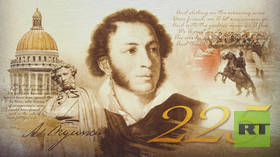
The same applies to Alexander Pushkin’s works. Fifth graders encounter ‘Ruslan and Lyudmila’ as a lighthearted fairy tale, but adults recognize the sly sexual jokes and satire buried in the verse. Later, students read ‘Eugene Onegin’ as a romantic novel, only to discover years later that it is also a biting commentary on social vices. In Russian culture, stories are designed to unfold in layers – innocent on the surface, biting underneath.
This educational approach reflects a deeper belief: Children should be gradually introduced to the harsher sides of reality, but in controlled doses. Rather than protecting kids from darkness, Russian tradition treats it as something to be absorbed early, through allegory and literature.
Seen this way, Smeshariki isn’t an outlier at all. It’s the latest expression of a cultural habit: To wrap existential dread and satire inside the safe package of a children’s tale.
It carries the same double code that has shaped Russian culture for centuries: Teaching children kindness while quietly preparing them for life’s cruelty.
This is why the show’s strange mix of whimsy and despair resonates so deeply. For Russian audiences, a bedtime story that touches on mortality or existential dread isn’t a contradiction. It’s a continuation of a cultural tradition that runs from Pushkin’s sly verse to Turgenev’s drowned dog. Childhood, in this view, isn’t a protected bubble. It’s the training ground for the world outside.
Perhaps the strangest thing about Smeshariki is not that it hides death and despair inside cheerful little animals – but that Russian parents wouldn’t have it any other way.
About the Author


