
Warning: This story contains images and the name of a deceased Indigenous person.
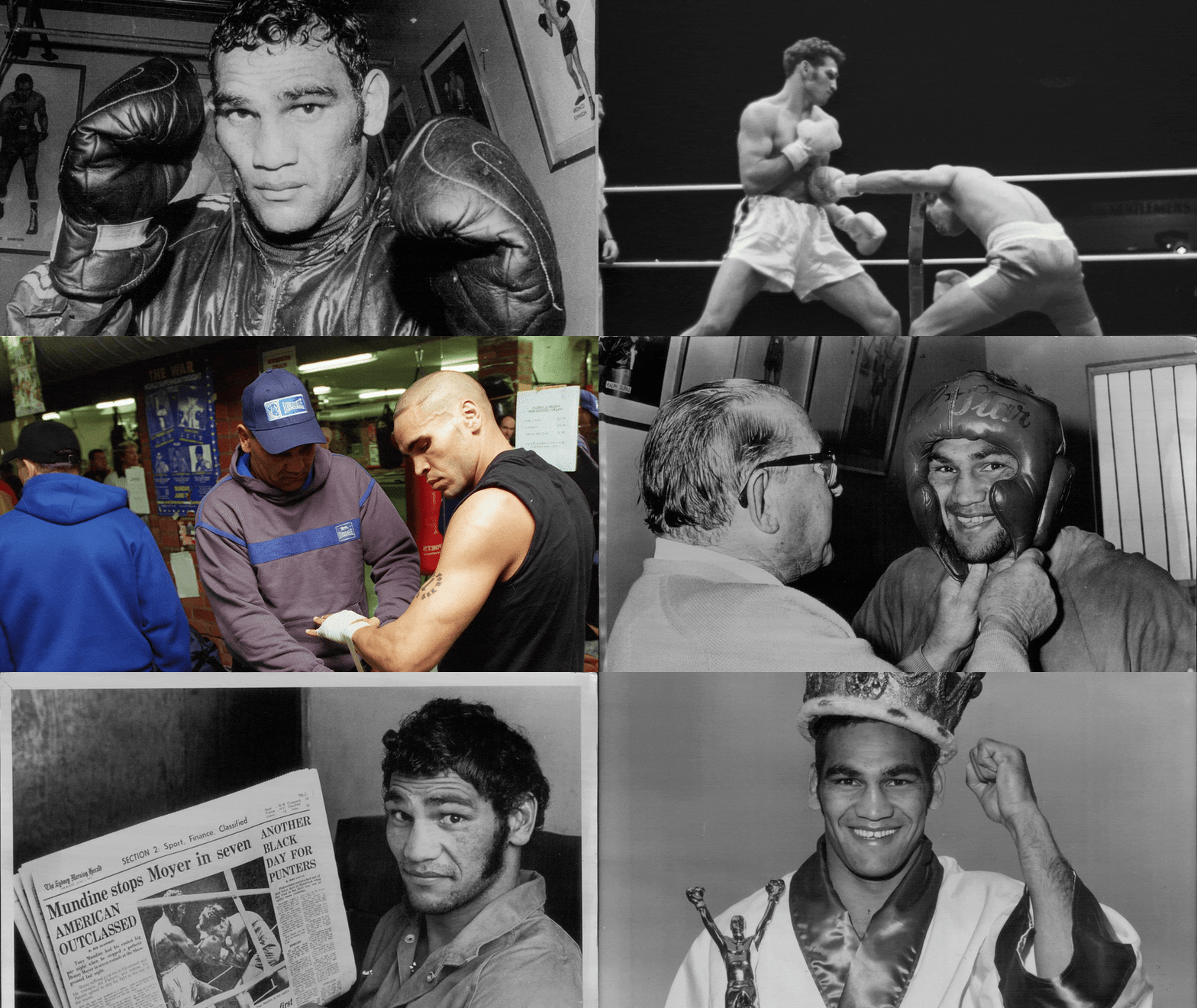
Tony Mundine OAM, who passed away on Sunday after a sudden heart attack at the age of 75, was a fine Australian, a great boxer and a man of steely resolve and quiet dignity.
While in later years he was best known to younger generations as the father of the notably brash rugby league player and world champion boxer Anthony Mundine, it was Mundine snr who forged the path in league and boxing that helped his son to flourish.
Tony Mundine’s upbringing was nothing if not rough, being born and raised in Baryulgil, a tiny Aboriginal community near Grafton.
“I knew hard times,” he once told boxing writer Grantlee Kieza. “We come from the Bundjalung people. Most people worked in the asbestos mines, and cancer was everywhere. My dad was 6ft 3in [190cm] and solid. When he died at 51, he was like a bloody matchstick. The cancer killed a lot of his brothers too, and some of my sisters.”
Their shack had no electricity or running water, and to help his mother get enough money to feed the nine kids, Mundine started work in the asbestos mine and as a stockman, before earning some extra money on the side by taking on fights with the travelling boxing show of Jimmy Sharman, which visited Grafton every October.
As the crowd roared, young Tony, with the flashing fists and fast footwork – reminiscent of his hero, the great Aboriginal boxer Lionel Rose – could more than hold his own.
“We’d get £5 to fight three or four rounds,” he told Kieza. “That was a lot of money back then, especially for a poor teenage boy. I had maybe half a dozen fights in the tents, and I did pretty good.”
Mundine moved to Sydney in the late 1960s, and it was with his fists that he continued to shine.
When Rose beat world champion Fighting Harada in Tokyo in 1968 to become the toast of Australia – no small feat for an Aboriginal man in a country that had only just granted its first inhabitants the vote – Mundine could suddenly see the potential in boxing. By his late teens, he was good enough for the great boxing trainer Ern McQuillan, the Johnny Lewis of his day, to agree to train him.
In 1969 Mundine turned professional, and reeled off a series of astonishing victories to become the Australian middleweight champ. Hungry for worthy opponents that would bring the crowds in, he had to leave the middleweight division to go to higher weight classes, becoming champion of the light-heavyweight and cruiserweight divisions, too, before getting among the heavyweights themselves.
On February 25, 1972, at Festival Hall in Brisbane, as the country looked on agog, the stripling young man, just 20 years old and weighing in at 74 kilograms, ringing wet, took on the famed and grizzled Australian heavyweight champion Frank Bibron, who was 10 years older, 21 kilograms heavier and five times meaner.
It proved to be a contest between old thunder and young lightning, and though Bibron was clearly the stronger man, it was Mundine’s sheer speed and energy that proved the telling factor. After wearing Bibron out for 10 rounds, Mundine threw a punch that felled the exhausted older man so alarmingly that the referee immediately stopped the fight.
Ladies and gentlemen, preee-senting the new middleweight, light-heavyweight, cruiserweight and now heavyweight champion of Australia … Tony Mundine!
Boxers who lost their way in the bright lights at this time, disoriented by sudden fame and fortune, and ill-equipped to cope with either, were myriad. Rose, in fact, had been arrested for breaking and entering.
But Tony Mundine coped. He was proud of not smoking, drinking, taking drugs or gambling, and later taught his son Anthony, born in 1975, that they were the “poisons of life.”
The one thing that escaped Mundine snr was becoming world champion, though he was at least a contender, fighting for the world middleweight championship against Carlos Monzón in 1974, only to lose in the seventh round.
By the time Mundine snr’s career finished in 1984, he had fought 97 times, won 80 and knocked out 64 opponents. He was never beaten by another Aussie, and his feat of being an Australian champion in four weight divisions has never been matched.
He became a successful trainer after retiring from the ring, and his most famous charge, of course, was his son Anthony, who became a world champion in the middleweight divisions despite not having taken up professional boxing until the extraordinarily late age of 25, after a successful rugby league career.
Their father-son relationship was always tight, though their training relationship was sometimes fraught, starting with the fact that Tony, aware of the damage that boxing could do, had originally discouraged his son from leaving league.
But, once Anthony “The Man” Mundine was committed, his father took him on, and they achieved great success, though Mundine snr did briefly leave the position in 2006 before the fight against Danny Green, on the reported reckoning that Anthony was listening to too many voices other than his own.
Anthony won that bout anyway.
As a father and son duo, they were far and away Australian boxing’s most accomplished with, of course, a marked contrast in their personalities, emblematic of the eras in which they were raised.
At heart, Tony Mundine remained the young Aboriginal man from Baryulgil, as astonished as he was content with how far he had come and what he had achieved.
The fact that Anthony wanted to take things higher still, to be world champion, to be outspoken on matters Indigenous is a credit to them both.
Vale, Tony Mundine OAM, a great Australian.
 Peter FitzSimons is a journalist and columnist with The Sydney Morning Herald.Connect via X.
From our partners
About the Author