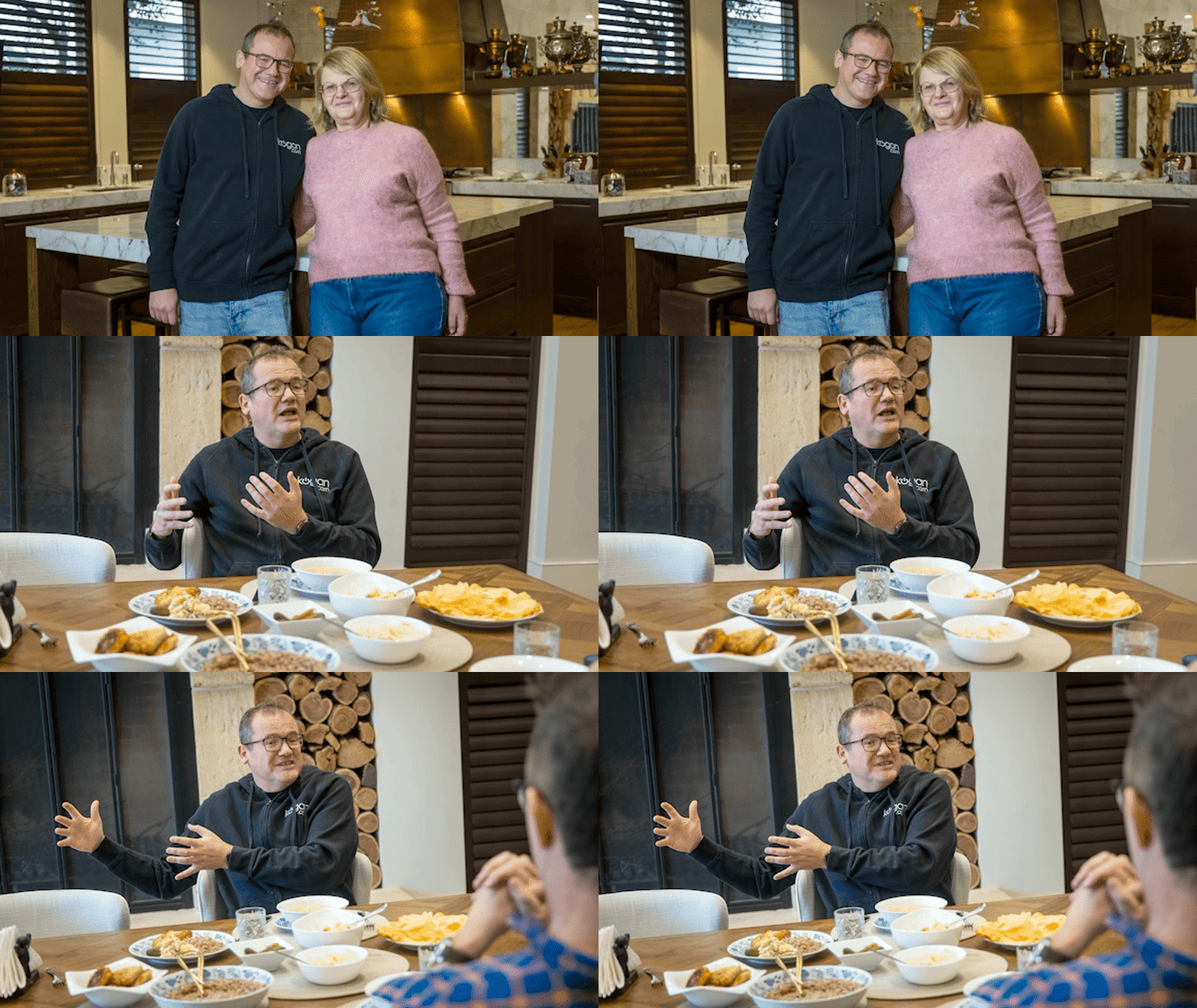
Ruslan Kogan has made millions using modern digital technology to do something old-fashioned – sell us household stuff.
And when asked to choose a favourite restaurant for this interview, as per the time-honoured conventions of the Lunch With series, the Belarusian Jewish, marathon-running tech entrepreneur, dad of three and enthusiast of 10-hour slow-cooked brisket does something highly unusual.
He requests we have lunch at his mum’s.
As the entrepreneur explains once Irene Kogan’s Belarusian feast has arrived at her dining table: “When I’ve been overseas, and no matter how much fine dining we’ve had in restaurants, as soon as I get back to Melbourne, what you’ve got in front of you is exactly what I’m craving.”
Few executives (actually few men) ever seem to publicly acknowledge their love for their mums like this, but the 43-year-old entrepreneur (a multimillionaire since his 20s thanks to his online retailer, kogan.com) has always done it his way. Pretty much ever since he arrived here in 1989 after his family fled the communist Soviet Union for Australia, the land of bananas and pineapples, which a six-year-old kid in the old Soviet Union had never seen before.

Alex and Irene Kogan and their children, Svetlana and Ruslan, arrived with $90, and first settled in Elsternwick housing commission flats in south-east Melbourne, but today we are about five kilometres north and several worlds away.
Irene and Alex Kogan’s imposing home in Melbourne’s mansion suburb of Toorak, a few blocks away from their children’s abodes, looks like a scaled down British Museum. Gravel crunches underfoot as I walk past two Teslas and mount steps leading to a grand portico.
What to expect? Ruslan Kogan is worth about $300 million (down from $575 million amid the pandemic shopping boom), has just slashed his salary by about $800,000 as part of a share incentive scheme, and while overseas recently, took to social media to complain about exorbitant hotel laundry fees. He ended up washing his T-shirts in the bath.
A boffin in a black hoodie branded with a Kogan logo opens the front door. Ruslan Kogan, with big glasses, slightly thinning hair and engagingly gappy teeth greets me with a precise but friendly accent once dubbed by The Australian as “south-east Melbourne via 1980s Belarus”.
Beyond the foyer with a vast sweeping stairway the living room faces onto a pleasant garden, the lounge to the left is dominated by one of the largest televisions I have ever seen.
To the right is a dining table, a kitchen and Irene, smiling and dressed in a pink jumper and jeans. Next to her is Anastasia Fai Kogan, Ruslan’s wife, a marketer and philanthropist involved with the Melbourne Opera, Australian Institute of Music and Arts Centre Melbourne.

Anastasia is known for show-stopping outfits at the National Gallery of Victoria Gala, but today is also wearing a pink jumper and denim jeans, which both women delightedly point out.
I give a box of Koko Black chocolates to Irene, who frets that the dishes will go cold while they are photographed. Ruslan, in a jovial mood, talks cooking. Turns out producing the perfect 10-hour slow-cooked brisket is just another outlet for the businessman’s geeky obsessiveness.
Within earshot of his wife, he jokes Anastasia used to chide him for regularly waking up in the middle of the night to check on the smoker, before technology came to the rescue. “I’ve got all these different probes and alarms that alert me, in case something happens.”
Such obsessiveness led Ruslan, who had worked in Telstra and at Accenture, to found his online retailer in 2006 with his credit cards, frustrated after searching for a decent television and realising he could to a better job making and marketing his own.
First up on Irene’s menu is chicken soup, a straw-coloured broth garnished with three carrots lying on a dense bed of noodles flecked with parsley.

Kogan declares his mum’s and Anastasia’s chicken soup to be the top two best chicken soups in the world. “And I’m not brave enough to go any further in the rankings,” he says.
More often than not, Kogan starts the day with a long run, along the Yarra, the famous Tan track around the Royal Botanic Gardens and around Albert Park, site of the Melbourne Formula 1 Grand Prix.
When he runs it’s a digital detox, without phone or headphones, only his Garmin fitness tracker (Kogan is an authorised seller) recording his progress.
“I don’t have the physique or the look of a marathon runner, but to me, there’s something about running that has always been really attractive … a form of meditation almost,” he says.
But it’s also customer research. As Kogan (who ran the 2022 Paris marathon in four hours, 44 minutes) runs, he listens, and increasingly the snatches of conversations he runs past are about the cost of living.
“We as a business are doing well,” he says. The cost-of-living squeeze makes cost-conscious consumers undertake more price comparisons, which suits Kogan (the business and the man).
He thinks Australia must foster entrepreneurship because we have limited resources and need to capitalise on our one major unlimited resource – the human mind.
But nobody fostered that with you, I point out. You just did it.
In Australia he was lucky, he responds. “In the sense that I had the privilege of growing up underprivileged. That created this hunger to want to build stuff and achieve things, and that’s why I started businesses from the age of 10.”
That job was cleaning and reselling discarded golf balls at the local golf club.
“I’ve said many times that what it takes to be an immigrant is very similar to what it takes to be an entrepreneur. During my most formative years, I witnessed my parents drop everything they’ve got in the Soviet Union, take a massive risk, travel into the unknown, work their butt off for a potential benefit that might not be there.”
The Kogan family story is a familiar immigrant story of parents accepting lesser jobs in the hope of gaining more. Alex, a major projects engineer in the Soviet Union, worked as a pizza delivery guy in Melbourne, at Queen Victoria Market and also as a labourer in a factory that made sponges. Irene, who had medical qualifications, worked in cafes and as a cleaner.

Kogan still remembers June 29, 1989.
The family arrived in Australia and went to their cousins’ home in Carnegie, a south-eastern suburb of Melbourne. There his cousin showed young Ruslan her computer. They played Space Invaders. For the six-year-old, it was “mind-blowing”.
At lunch, I am on unfamiliar but comforting terrain. After the soup, a plate arrives artfully arranged by Anastasia. The kotleti chicken cutlets – moist and tender pan-fried patties are lightly flavoured and pure comfort food. Alongside are a couple of pickles, a spread of nutty buckwheat, and a thick dollop of Olivier salad (comprising diced boiled potatoes, peas, carrots and mayonnaise, and richer and tangier than a standard potato salad). Nalisniki – crêpes with jam – follow for dessert.

Kogan’s schoolmates from government-run selective Melbourne High School like to observe his ability to amiably move through vastly different socio-economic worlds. But moving to Toorak, with Anastasia in 2018, two years after kogan.com floated on the stock market, required adjustment.
“There’s lots of bits about it that I don’t like,” he says of his adopted suburb.
“Everyone’s got really tall fences. There’s very little interaction as a community.
“I remember when we moved in, we printed off pamphlets saying, ‘Hey, we’re moving in. We really look forward to being part of this community. Here’s a photo of our dog. We would love to meet you’.”
They received one response.
In 2010, fast on his way to becoming Australia’s richest person under 30, Ruslan Kogan was out drinking with mates at Justin Hemmes’ Ivy bar in Sydney, when he spotted a woman in the bar he was convinced was Russian.

“I was pretty drunk, and I walked up and said, ‘I can tell with 100 per cent certainty you’re Russian’,” he recalls.
Anastasia replied: “I can tell with 100 per cent certainty you’re an idiot.”
Kogan now says: “I think with that quick quirky comeback she had me. I was right about the Russian, she was right about the idiot.”
Fast forward 16 years later and the couple have two young daughters and a son. Kogan says he and Anastasia have a lot in common but are very different.
“I’m more like, take me to a factory and show me how door handles are made. Whereas … she’ll be like, ‘We can’t go to Paris without the Louvre’.
“I’ll be there complaining this isn’t a good place to take a four-year-old and a two-year-old and a one-year-old, but she still forces us to do it.”
At one point Kogan talks about his birthplace while talking about his Toorak neighbours.
“I was born in a shithole little town called Babruysk, and” – here he waves over the fence – “that’s a family with heritage from about 50 kilometres down the road, an incredible retail family that built an incredible business. But through some businesses being asleep at the wheel, we were able to build a significant business in Australian online retail.”
Kogan is talking about the Myer retail family. Patriarch Sidney Myer was born in Belarus in 1878 to a Jewish family before immigrating to Australia in 1899 and founding the Myer retail empire.
Has he met any of the Myers, I wonder? “No.”
The COVID-19 lockdowns were wild for kogan.com. The company rode its zenith and nadir along with online buyers trapped at home. At one stage, the business’s market capitalisation was more than 10 times the size of Myer. But the comedown was painful, the company massively overstocked, and it created a business crisis as it had to slash prices. The market cap of both companies is now similar.
But Kogan prefers the future and believes in artificial intelligence, so much so that he deploys an AI avatar to give annual result presentations to investors. A more efficient use of his time, he says, is doing away with the need to re-record his presentation when market forecasts change. And AI will help customers searching for a deal to find the Kogan website, he believes.
“Not only are we surviving. Yeah. We’re thriving.We are winning market share against global organisations who are many times bigger than us.”
Kogan stays out of politics, though he called for a royal commission into the Bondi massacre, but his rise to business prominence has not been without controversy. He has a long-standing feud with rival retailer Gerry Harvey, and Kogan once labelled “work from home” as “wanking from home”.
He says that at school, “I was always getting top marks, but there were very few teachers who liked me” and his reputation was as a disruptive class clown.
“I think a lot of truth is said in jests,” he muses.
Then there was his controversial “ball-tampering” joke, which tied the Australian cricket team sandpaper scandal to celebrity trans woman Caitlyn Jenner, who was born a biological male Bruce Jenner.
“What I thought, it was a bit of fun, but there were a few people offended by it,” he says.
How does he feel about it now? He pauses and looks out over the manicured lawn.
“My parents went through a lot of shit to escape a place without freedom of speech,” he replies.
He admits that he may well have done a bad job of trying to be funny.
“That’s one of the leading indicators to a decline in a free society … when comedians need to start apologising.”
Read more great conversations over lunch
About the Author


