
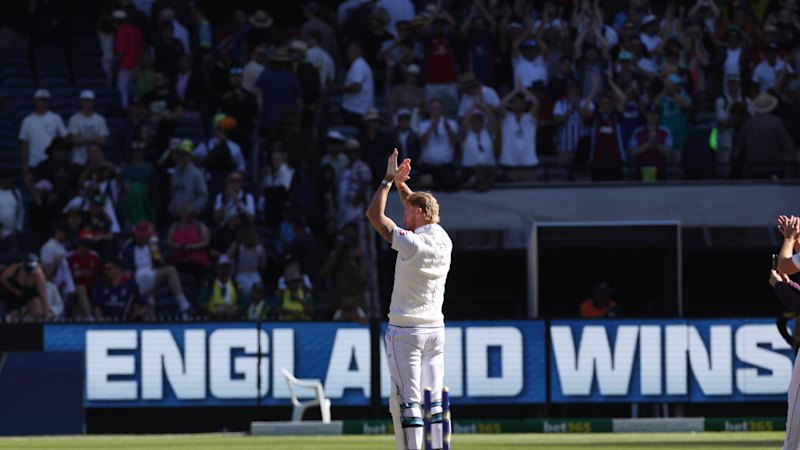
Their aggressive approach prevented Australia’s attack from grouping deliveries in the most dangerous region of the pitch and worry England into error.
Scott Boland was the most threatening of Australia’s pacemen but was not introduced into the attack until the 11th over when England already had 70 on the board.
“I was very pleased with how brave we were and committed to a style of play we knew was the best chance of chasing that down,” Stokes said.
“Chasing 170 on a wicket like that was never ever going to be easy. When you put everything into consideration with the build-up to this Test match, the conditions we faced, to chase 170 down you could almost say it felt like 340. It was tough, but I loved the way we went about that.
“We didn’t let a very good bowling attack feel like they were able to settle into the areas they wanted to be able to bowl to give them the best chance to take our wicket.”
Christmas week started with the blowtorch firmly on England’s off-field antics and will finish with the microscope on Australia’s willow-wielders and the MCG’s seamer’s paradise, which produced just the 27th two-day Test in the format’s 148-year and 2615-game history.
Loading
With more than 90,000 expected to have come for day three, the early finish will cost CA $10 million in lost revenue, according to a source with knowledge of the matter.
This was Australia’s first defeat to England at home since the Sydney Test in January 2011 when a third innings humiliation sparked a root and branch review into the national team.
Back then, Smith, the stand-in captain in this game, was a wide-eyed 21-year-old yet to score a Test hundred who had been brought into the Australian XI to inject fun and laughter into a demoralised team, an injured Ricky Ponting was nominally the Test captain and Julia Gillard was the prime minister in a minority government.
“We’d love to win every game and keep every streak going,” Smith said. “England played really well today. We probably controlled the first half of the game, they came back to play today and took the game away from us, particularly the way Duckett and Crawley started, broke the back of the chase and softened up the ball.”
Loading
The blame for Australia’s defeat should be carried by their batters. Presented with the opportunity to bat England out of the game, Australia crumbled for the second time in as many days, losing 8-71 in 107 balls.
Though Australia have the urn safely in their keeping, the batting remains a major problem, as it has been for the best part of two years.
Only three of the team’s top seven – Travis Head, Steve Smith and Alex Carey – are averaging above 40 this series or playing in a manner that demands automatic selection.
Recalled for this series after a hot run at domestic level, Marnus Labuschagne’s twin failures in Melbourne resulted in him finishing 2025 with an average of 20.84, the lowest in a calendar year by a top-four Australia batter since 1981.
Loading
Veteran Usman Khawaja took the gloss off his revival in Adelaide by falling for a second-ball duck with an ungainly pull shot to the pace of Josh Tongue.
Cameron Green, the only other Australian to reach double figures, did little to lock away his place for the Sydney Test, losing his wicket to an uncomfortable fend well outside off stump.
Head combined enterprising, but not reckless, strokeplay with sound defence for 46, and Smith trusted his technique for an unbeaten 24, but the others could neither score nor survive for long enough to make it count.
Unlike earlier this series, there was no bailout from Carey or the tail.
News, results and expert analysis from the weekend of sport are sent every Monday. Sign up for our Sport newsletter.


