
Secretary of State Marco Rubio now suggests the United States won’t govern Venezuela other than enforcing an existing “oil quarantine” on the country.
WASHINGTON — Hours after an audacious military operation that plucked leader Nicolás Maduro from power and removed him from the country, President Donald Trump said Saturday that the United States would run Venezuela at least temporarily and tap its vast oil reserves to sell to other nations.
“We’re going to run the country until such time as we can do a safe, proper and judicious transition,” Trump said at a Mar-a-Lago news conference where he boasted that this “extremely successful operation should serve as warning to anyone who would threaten American sovereignty or endanger American lives.”
The dramatic action capped an intensive Trump administration pressure campaign on the South American nation and its autocratic leader and months of secret planning resulting in the most assertive American action to achieve regime change since the 2003 invasion of Iraq.
Trump’s vow to “run” Venezuela has since sparked concerns among some Democrats. It also drew unease from parts of his own Republican coalition, including an “America First” base that is opposed to foreign interventions, and also from observers who recalled past nation-building efforts in Iraq and Afghanistan.
Here’s what we know about U.S. plans to “run” Venezuela.
How would the U.S. “run” Venezuela?
Secretary of State Marco Rubio suggested Sunday that the United States would not take a day-to-day role in governing Venezuela other than enforcing an existing “oil quarantine” on the country, a turnaround after Trump’s Saturday announcement,
Rubio’s statements on TV talk shows seemed designed to temper concerns about whether the assertive American action to achieve regime change might again produce a prolonged foreign intervention or failed attempt at nation-building. They stood in contrast to Trump’s broad but vague claims that the U.S. would at least temporarily “run” the oil-rich nation, comments that suggested some sort of governing structure under which Caracas would be controlled by Washington.
Venezuela is known to have the world’s largest proven crude oil reserves of approximately 303 billion barrels, according to the U.S. Energy Information Administration. That accounts for roughly 17% of all global oil reserves.
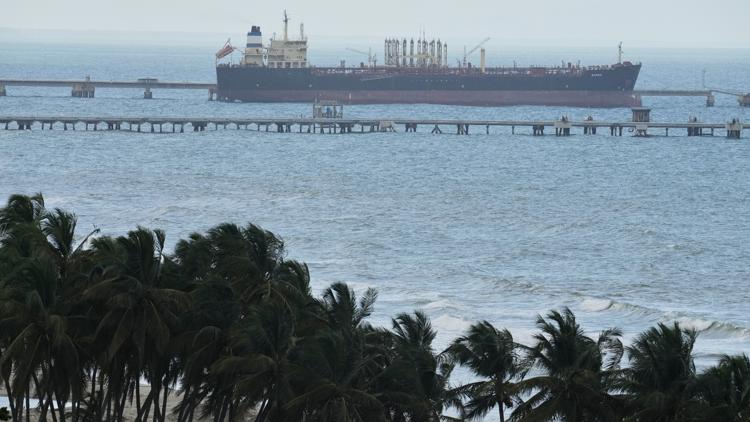
Rubio said the U.S. would continue to enforce an oil quarantine that was already in place on sanctioned tankers before Maduro was removed from power early Saturday and use that leverage as a means to press policy changes in Venezuela.
“And so that’s the sort of control the president is pointing to when he says that,” Rubio said on CBS’ “Face the Nation.” “We continue with that quarantine, and we expect to see that there will be changes, not just in the way the oil industry is run for the benefit of the people, but also so that they stop the drug trafficking.”
The blockade on sanctioned oil tankers — some of which have been seized by the U.S. — “remains in place, and that’s a tremendous amount of leverage that will continue to be in place until we see changes that not just further the national interest of the United States, which is number one, but also that lead to a better future for the people of Venezuela,” he added.
Rubio also suggested that the U.S. would give Maduro’s subordinates who are now in charge time to govern, saying, “We’re going to judge everything by what they do, and we’re going to see what they do.” And though he did not rule out a U.S. military presence in Venezuela, Rubio said the current U.S. “force posture” was capable of stopping drug boats and sanctioned tankers.
Trump indicated Saturday that Delcy Rodríguez, who is next in the presidential line of succession, had been sworn in already as president of Venezuela, per the transfer of power outlined in the constitution.
But state TV did not broadcast any swearing-in ceremony.
During Rodríguez’s televised speech, a ticker at the bottom of the screen identified her as the vice president. She gave no sign that she would be cooperating with the U.S., and did not immediately respond to a request for comment.
“What is being done to Venezuela is an atrocity that violates international law,” she said in her address. “History and justice will make the extremists who promoted this armed aggression pay.”
The Venezuelan constitution also says a new election must be called within a month in the event of the president’s absence. But experts have been debating whether the succession scenario would apply here, given the government’s lack of popular legitimacy and the extraordinary U.S. military intervention.
The Associated Press contributed to this report.


