
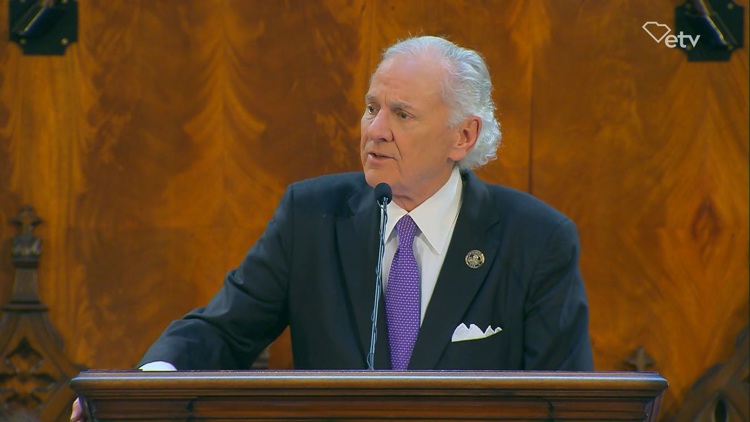
McMaster has served as the state’s chief executive since 2017.
COLUMBIA, S.C. — Gov. Henry McMaster used his ninth and final State of the State address to outline what he described as South Carolina’s strengths, while urging lawmakers to continue investing in infrastructure, education and long-term economic growth.
Speaking before a joint session of the General Assembly, McMaster opened by honoring four first responders who died in the line of duty in 2025, offering condolences to their families and recognizing their service.
From there, the governor reflected on his nine years in office and framed the address around what he called South Carolina’s “commerce, conservation and consequence,” saying the state is entering what he described as the “South Carolina Century.”
Infrastructure funding
A major focus of the address was transportation and infrastructure spending. McMaster reiterated his call for lawmakers to invest an additional $1.1 billion in surplus funds for road projects across the state.
According to the governor, South Carolina currently has nearly $7 billion in active transportation projects underway, compared to $2.7 billion in 2017. He said rising construction and labor costs threaten to delay those projects unless additional funding is approved.
“It’s critical that this year’s budget invest an additional $1.1 billion in new surplus money to keep them moving and on schedule,” McMaster said.
He also warned that continued population growth could strain infrastructure if it is not addressed, pointing to potential future challenges involving traffic congestion, water and sewer access, and public services.
Economic growth and development
McMaster also highlighted what he described as strong economic performance in South Carolina, pointing to large budget surpluses and continued business investment.
“Today our economy is strong, creating large budget surpluses — year after year,” the governor said.
McMaster said the state announced more than $9.1 billion in new capital investment and more than 8,100 new jobs last year, citing projects in counties including Allendale, Pickens, Clarendon, Greenville and Spartanburg. Since 2017, he said South Carolina has announced more than $53 billion in new capital investment and nearly 100,000 new jobs.
The governor attributed that growth to what he described as business-friendly policies, population growth and reductions in the state’s personal income tax rate. He again urged lawmakers to continue cutting taxes and said he would support eliminating the personal income tax if the General Assembly sends such legislation to his desk.
Education priorities
Education was another central theme of the address, with McMaster emphasizing teacher pay, early childhood education and workforce preparation.
He said the state plans to raise the minimum starting teacher salary from $48,500 to $50,500 this year, which he described as a 68% increase since 2017.
“We should keep raising it,” McMaster said, arguing that higher salaries have helped reduce teacher vacancies and raise average pay statewide.
The governor also highlighted the expansion of full-day, four-year-old kindergarten, known as 4K. He said enrollment has increased by about 30% since the program’s statewide expansion and urged lawmakers to move toward universal full-day 4K, regardless of household income.
In addition, McMaster pointed to workforce training initiatives, including free technical college scholarships, which he said have helped more than 120,000 South Carolinians earn post-secondary or industry credentials.
Looking ahead
McMaster closed the address by calling on lawmakers to continue what he described as a collaborative approach to governing, while emphasizing conservation, public safety and long-term planning.
“I have faith in our people, and I have faith in those whom they have elected to represent them here in this State House,” he said.
Democratic response
Following Gov. Henry McMaster’s address, Democratic Rep. Jermaine Johnson delivered the party’s official response, offering a sharply different assessment of South Carolina’s condition.
Johnson, who represents House District 52, said the governor’s speech focused on economic indicators that he argued do not reflect the everyday reality for many families.
“Tonight, South Carolinians heard Governor McMaster describe a South Carolina that, on paper, looks strong,” Johnson said. “But is this really how we’re doing?”
Johnson said he believes the true state of South Carolina can be found “at kitchen tables across South Carolina,” where families are deciding whether they can afford rent, groceries, school supplies or medication.
He pointed to Republican control of state government for more than two decades, saying the results have fallen short in key areas that affect daily life.
“After all that time, South Carolina remains near the bottom nationally in the areas that most directly affect everyday life,” Johnson said.
Johnson cited national rankings that he said place South Carolina 43rd in education, described the state’s roads and bridges as among the worst in the country, and said South Carolina has one of the highest homicide rates in the nation. He said those conditions leave “our neighbors less safe,” “our children worse educated,” and “our infrastructure crumbling.”
Johnson also criticized state leaders for what he described as a failure to address wages, healthcare access and public education.
“If they truly cared about you, they would have fixed public education. If they truly cared about you, they would have fixed the roads,” Johnson said. “They would have created a livable, minimum wage. They would have fixed our healthcare system.”
He called for additional investment in rural hospitals, expanded mental health services in schools and healthcare facilities, and policies he said would make healthcare more affordable.
Johnson also raised concerns about reproductive healthcare, saying women in South Carolina have seen their rights restricted and that personal medical decisions should not involve government interference.
On economic development, Johnson said recent electric vehicle and battery plant projects were made possible by what he described as Democratic-led federal investments in clean manufacturing. He argued Republicans opposed those measures before later taking credit for the resulting jobs.
“We understand the difference between doing the work and taking the credit,” Johnson said.
Johnson also suggested the state explore additional revenue sources, including regulated medicinal cannabis and expanded gaming, which he said could generate tax revenue and support public services.


