
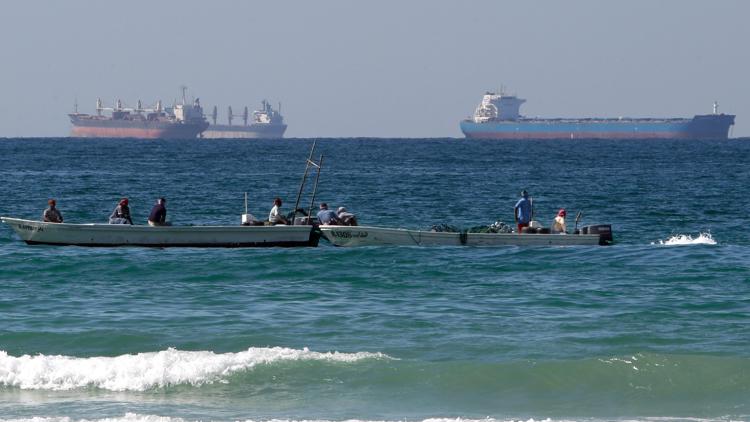
The price of crude oil in the U.S. has jumped since airstrikes in Iran began Saturday. Now that the Strait of Hormuz is closed, prices are expected to climb higher.
WASHINGTON — Gas and oil prices in the U.S. are expected to continue rising amid the ongoing conflict with Iran and escalating tensions in the region, leading to the closure of one of the most vital passageways for oil trade.
According to AAA, the national retail average for a gallon of gasoline as of Tuesday, March 3, was $3.109. That’s up from $2.997 per gallon the day before.
Roughly a fifth of all oil traded globally passes through the Strait of Hormuz, a narrow passage between the Persian Gulf and the Gulf of Oman.
The strait is governed by international law, but Iran has significant control over the waterway. The strait has never been closed before, though shipping was disrupted in the 1980s.
“The Strait of Hormuz is closed,” declared Iranian Brig. Gen. Ebrahim Jabbari, an adviser to the paramilitary Revolutionary Guard, threatening to set fire to any ships attempting to transit. “Don’t come to this region.”
The reported closure of the strait is expected to further increase the cost of crude oil, which has already been on the rise.
Since the U.S. and Israel began airstrikes in Iran on Saturday, the price of crude oil in the U.S. has jumped more than 5%, to $70.86 per barrel. Brent crude, the international standard, climbed 6.2% to $77.36 per barrel.
Crude oil prices are the driving factor for the cost of gasoline, with higher prices per barrel directly tying to consumers paying more at the pump. According to the federal government, there’s a general rule that for every $1 change in the price of oil, there’s roughly a 2.4-cent change per gallon of gas.
As U.S. and Israeli strikes against Iran continue, some experts believe the cost of a barrel of oil could reach $100 or more, which Dr. Jack Buffington, program director of supply chain management at the University of Denver, called a “tipping point” for domestic gas prices.
“There’s potential for oil prices to go up to $100 a barrel, which is kind of seen as a tipping point,” Buffington said. “If it goes higher than that, you see airlines starting to bleed money, you start to see really significant problems.”
The immediate consequence, Buffington said, is driven less by physical blockage than by financial exposure. Insurance costs for tankers attempting to navigate the strait have surged, with some carriers unable to obtain coverage at all and others facing rate increases of 50%.
“What matters is what the financial and insurance markets will accept as risk,” Buffington said.
Over the weekend, video emerged of oil tankers in the strait on fire. The video, as well as threats by Jabbari and other Iranian officials, caused prices to rise quickly.
“Those images go a long way of persuading people that it probably isn’t a journey that people want to make until things have calmed down a little bit,” said Tyler Schipper, an economics professor at the University of St Thomas.
And prices are unlikely to go down again quickly. President Donald Trump said Monday the operation in Iran was expected to last for about four or five weeks, but could stretch longer.
The Strait of Hormuz: a key waterway for global shipping
The Strait of Hormuz is a bending waterway, about 33 kilometers (21 miles) wide at its narrowest point. It connects the Persian Gulf to the Gulf of Oman. From there, ships can then travel to the rest of the world. While Iran and Oman have their territorial waters in the strait, it’s viewed as an international waterway all ships can ply. The United Arab Emirates, home to the skyscraper-studded city of Dubai, also sits near the waterway.
The strait through history has been important for trade, with ceramics, ivory, silk and textiles moving from China through the region. In the modern era, it is the route for supertankers carrying oil and gas from Saudi Arabia, Kuwait, Iraq, Qatar, Bahrain, the UAE and Iran. The vast majority of it goes to markets in Asia, including Iran’s only remaining oil customer, China.
While there are pipelines in Saudi Arabia and the UAE that can avoid the passage, the U.S. Energy Information Administration says “most volumes that transit the strait have no alternative means of exiting the region.”
The Associated Press contributed to this story.


