
Political science professor Michael Bitzer analyzes primary results, from a historically tight state Senate race to an unexpectedly high Democratic turnout.
CHARLOTTE, N.C. — North Carolina’s primary election has handed political observers their first concrete data point of the 2026 cycle, and Catawba College political science professor Michael Bitzer says the numbers are telling a story Democrats will want to hear and Republicans should not ignore.
Bitzer, one of the state’s most closely watched election analysts, joined WCNC+ on Wednesday to break down the results, from a historically tight state Senate race to an unexpectedly high Democratic turnout in an uncontested U.S. Senate primary.
A two-vote race that could reshape North Carolina politics
No result drew more attention than the Republican primary for state Senate District 26, where Senate President Pro Tempore Phil Berger — widely considered the most powerful figure in North Carolina politics — found himself trailing challenger Sam Page by just two votes.
Berger has led the state Senate for roughly 15 years, wielding influence that, in many respects, exceeds that of the governor. The razor-thin margin sent the race toward a potential recount, with military ballots still outstanding under a federal deadline and mail-in and provisional votes yet to be counted.
“It certainly could [go either way], and you’re right, the military votes are still coming in,” Bitzer said. “They may come in actually through March 12. That’s federal law. Then you have the issue of perhaps some mail-in ballots needing to be cured, needing to be counted, ultimately all of those provisional ballots that are outstanding potentially in that district.”
He said the stakes extend well beyond one legislative seat.
“For the past 15 years, North Carolina has been reshaped by Phil Berger and his operations in terms of political strategy,” Bitzer said. “If Phil Berger ultimately loses this race, there will be a fight to become the Senate leader. We could see some potential movement on the budget. There’s going to be a fundamental reshaping of North Carolina politics. It’s a new day in terms of the state’s politics.”
Strong turnout for Democrats
While Berger’s race dominated headlines, Bitzer said the most significant data point may have been buried in the uncontested Democratic U.S. Senate primary.
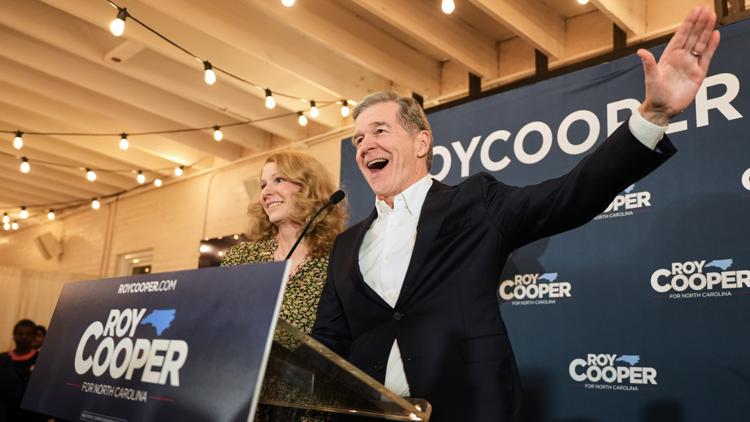
Former Gov. Roy Cooper won the Democratic nomination in what Bitzer described as a coronation, yet more than 200,000 more voters participated in the Democratic primary than in the Republican primary. The gap caught the attention of analysts on both sides.
“There are a lot of people energized, a lot of people wanted to participate in the Democratic primary, even though there was really nothing statewide drawing them to that race,” Bitzer explained. “The race was actually on the Republican side. To see that 200,000 vote imbalance really sends a signal to me that this is something to watch over the next eight months as we lead into the general campaign.”
Bitzer said the turnout gap raises the central question of the fall campaign season: Can Democrats sustain that energy through the midterms?
“Does that then translate to a Democratic wave potential going into the fall? We’ll have to watch all this closely, but this is a sign that we need to start paying attention to these dynamics,” he said.
A warning to party defectors
Democratic state Sen. Carla Cunningham’s primary defeat — a blowout, by Bitzer’s description — offered a sharp illustration of how thoroughly the state’s political parties have sorted themselves.
Cunningham was among three Democratic legislators who had sided with Republicans on gubernatorial vetoes. All three faced primary challengers. All three lost. A separate Democrat who had broken with his party two years earlier also attempted a comeback and was defeated.
“The biggest surprise was the absolute blowout in terms of the percentages, and what this really says to me is that not only are the voters party loyalists now, but the parties are expecting their elected representatives to be party loyalists — to be allegiance to the party — and when you buck the party, the party can kick back,” Bitzer said.
He said the results reflect a broader trend transforming North Carolina’s political landscape.
“We have sorted our political parties. We have sorted as voters into like-minded communities, and I think that the intensity of the polarization and division in the state is only going to get more extreme,” Bitzer said.
Previewing November: “A midterm unlike any other”
With President Donald Trump back in the White House and Democrats showing unusual enthusiasm in a low-stakes primary, Bitzer said the structural conditions for a strong midterm backlash are taking shape.
“The Trump administration is going to be the primary target of that energy and enthusiasm,” Bitzer said. “If the economy continues to be forefront, that double whammy is really setting us up for a midterm unlike any other in terms of the magnitude that we might be seeing.”
He said he will be closely watching the generic ballot, the broad polling question asking voters whether they plan to vote Democratic or Republican, as one of the clearest early indicators of the November environment. Midterms historically favor the party out of power, and Bitzer said that dynamic appears particularly potent heading into 2026.
The unaffiliated wild card
North Carolina’s 7.6 million registered voters include a large and growing bloc of unaffiliated voters, a group neither party can afford to overlook. But Bitzer cautioned against reading too much independence into the label.
“The great mass of unaffiliated voters is the largest percentage within the 7.6 million registered voters of North Carolina, but they are not political independents,” Bitzer explained. “They tend to lean to one party over the other. North Carolina swing voters, those folks who bounce down the ballot, who are the persuadable voters, is a shrinking pool of voters.”
Early primary data suggested unaffiliated voters who cast ballots may have gone disproportionately Democratic. Bitzer said he views that trend as a potential early indicator of where they will land in November.
“My suspicion is that indeed those folks who are registered unaffiliated who voted probably went much more Democratic, like the overall dynamic, and that indicates to me that’s where the independents, so-called, are going to go potentially in November,” Bitzer said.
For the latest breaking news, weather and traffic alerts that impact you from WCNC Charlotte, download the WCNC Charlotte mobile app and enable push notifications.


