
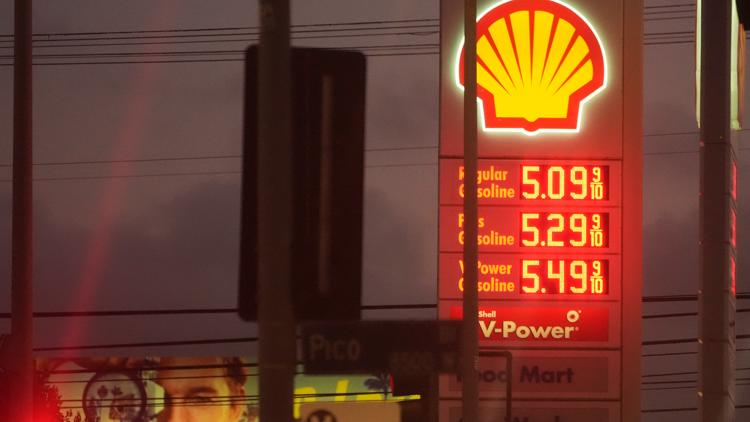
The first ten days of March have seen a big rise in gas prices in the U.S., with a gallon of fuel costing 50 cents more than it did in February.
WASHINGTON — Gas prices in the U.S. continued rising Tuesday as the conflict in Iran escalates, with the national average cost per gallon rising another six cents overnight.
On Tuesday, the average price for a gallon of gas in the U.S. was just under $3.54, up six cents from Monday’s prices, according to price-tracking information collected by AAA.
Tuesday also marked the end of sub-$3 gas for all but one state. In Kansas, a gallon of gas costs an average of $2.96, AAA data showed on Tuesday, but every other state has an average price that has crept over the three-dollar mark. California has the most expensive gas in the country, with a gallon costing an average of $5.29.
The first ten days of March have seen a big rise in gas prices in the U.S. At the end of February, when the U.S. attack on Iran began, gas prices were hovering around $2.95 per gallon. But the conflict’s impacts on global oil production have caused daily spikes in prices.
Oil prices are down a bit Tuesday after jumping to a high of $120 per barrel of Brent crude on Monday. The past few days have seen large fluctuations in prices throughout the day, with wild swings over the weekend as producers took stock of what may be a long and protracted conflict in the Middle East.
Analysts with GasBuddy, a fuel price-tracking website, said the price of oil hitting the $100-per-barrel mark over the weekend could have widespread ripple effects across the economy as markets across the U.S. recalibrate how expensive shipping will be.
“In just a week, consumers have seen gasoline prices surge at one of the fastest rates in years after oil prices spiked following U.S. strikes on Iran and the effective closure of the Strait of Hormuz,” said Patrick De Haan, head of petroleum analysis at GasBuddy. “With additional attacks across the Middle East over the weekend pushing oil above $100 per barrel for the first time in years, fuel markets are now rapidly recalibrating to the risk of prolonged disruption to global supply flows.”
De Haan predicted that gas prices aren’t done rising yet, and the average could hit $4 per gallon before steadying.
“Gasoline prices in many states could climb another 20 to 50 cents per gallon this week, with price-cycling markets potentially seeing increases as early as today,” he said Monday. “Diesel may rise even more sharply, with increases of 35 to 75 cents per gallon possible as global distillate markets react. While the situation remains highly fluid, consumers are already beginning to feel the impact as energy markets adjust to this sudden escalation.”
What is the Strait of Hormuz?
The cost of oil is rising partly because of Iran’s stranglehold on tanker movement through the Strait of Hormuz, the narrow mouth of the Persian Gulf through which about a fifth of the world’s oil is shipped.
The strait is governed by international law, but Iran has significant control over the waterway. The strait has never been closed before, though shipping was disrupted in the 1980s.
However, Iran has recently attacked several ships in the Strait of Hormuz and threatened any ships that try to pass through, effectively closing it.
“The Strait of Hormuz is closed,” declared Iranian Brig. Gen. Ebrahim Jabbari, an adviser to the paramilitary Revolutionary Guard, threatened to set fire to any ships attempting to transit. “Don’t come to this region.”
Crude oil prices are the driving factor for the cost of gasoline, with higher prices per barrel directly tying to consumers paying more at the pump. According to the federal government, there’s a general rule that for every $1 change in the price of oil, there’s roughly a 2.4-cent change per gallon of gas.


