
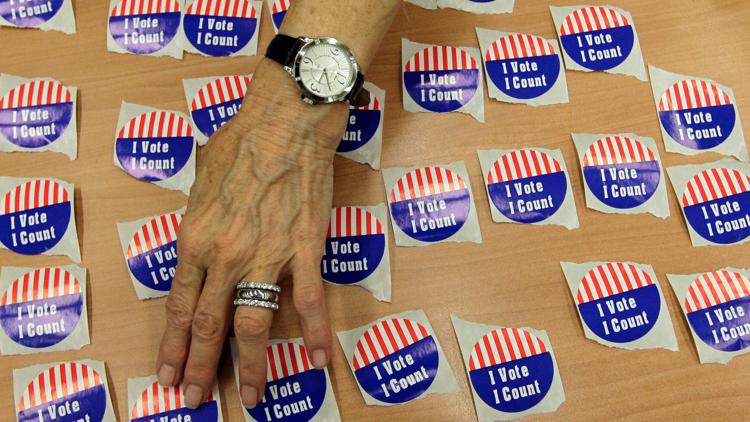
Voters in Texas, North Carolina and Arkansas are heading to the polls Tuesday, for the first midterm primaries.
WASHINGTON — Voters in three states—Texas, North Carolina and Arkansas—are heading to the polls Tuesday, marking the official start of midterm elections.
The results of the primaries will determine which Republicans and Democrats face off in a number of key races during the general election in November.
The most hotly contested races of the day are in Texas, with fierce competition on both sides for U.S. Senate nominations. It’s possible that the Republican campaign will continue into a runoff.
The primaries will stretch all the way into September before the general election in November that will determine control of Congress and statehouses around the country.
Arkansas
Arkansas voters will choose nominees for a full slate of federal, state and local offices in primary elections Tuesday.
The winners will face off in November’s midterm elections in a state that hasn’t elected a Democrat to statewide office since 2010. Besides statewide positions, Republicans also occupy the state’s four U.S. House seats and hold lopsided majorities in both chambers of the state Legislature.
Republican U.S. Sen. Tom Cotton faces two primary opponents in his bid for a third term. The Democratic nominee will be either Lewisville Mayor Ethan Dunbar or farmer and small business owner Hallie Shoffner.
Republican Gov. Sarah Huckabee Sanders seeks a second term in 2026, but she is running unopposed in the primary. The state’s Republican lieutenant governor, attorney general, auditor and treasurer also face no primary challengers in their reelection bids.
State Sen. Fred Love and magazine publisher Supha Xayprasith-Mays seek the Democratic nomination to unseat Sanders in November. Xayprasith-Mays also ran in 2022 but placed a distant fourth in the Democratic primary.
Contested primaries will also be held for secretary of state, commissioner of state lands, two U.S. House seats and more than two dozen state Senate and state House seats.
Competitive statewide nomination contests have been relatively rare in Arkansas in recent years. Cotton was unopposed in his 2014 and 2020 primaries, and Sanders and Republican U.S. Sen. John Boozman won their 2022 primaries with 83% and 66% of the vote, respectively.
In Arkansas, if no one receives more than 50% of the primary vote, the top two finishers advance to a March 31 runoff.
Arkansas does not have automatic recounts, but candidates may request and pay for one, with the costs refunded if the outcome changes.
Polls close at 7:30 p.m. local time, which is 8:30 p.m. ET.
North Carolina
North Carolina voters will narrow down the field of candidates Tuesday in a competitive U.S. Senate race that could decide control of the closely divided chamber in November. Also on the ballot are contested primaries for U.S. House, state Senate and House and the state Court of Appeals.
Even before Republican Sen. Thom Tillis announced his retirement last June, North Carolina presented Democrats with one of their few opportunities to flip a Republican-held seat in an otherwise difficult electoral map. Republicans hold a 53-47 majority in the U.S. Senate, and Democrats need a net pickup of four seats to win back the chamber.
A dozen candidates – six Republicans and six Democrats – are running to succeed Tillis. Tuesday’s winners will face off in the November general election.
The most prominent name in the Republican field is Michael Whatley, the former Republican National Committee chair who has President Donald Trump’s backing. Also running are author and attorney Don Brown and conservative activist Michele Morrow, both of whom ran for other offices in 2024. Brown sought the GOP nomination in the 8th Congressional District, while Morrow ran a competitive race for Superintendent of Public Instruction. One former GOP candidate, Margot Dupre, will appear on the ballot, but the state Board of Elections disqualified her candidacy.
In the Democratic primary, former two-term Gov. Roy Cooper faces five other candidates. Both Whatley and Cooper have far out-raised their primary competitors.
Congressional primaries will be held on a new map – the state Legislature drew new district boundaries in 2025 as part of Trump’s push to gain House seats through mid-decade redistricting. In the 1st Congressional District, which was redrawn to favor the GOP, five Republicans are running to challenge Democratic U.S. Rep. Don Davis. Laurie Buckhout, who narrowly lost to Davis in 2024, is running again and faces Carteret County Sheriff Asa Buck, state Sen. Bobby Hanig, Lenoir County Commissioner Eric Rouse and attorney Ashley-Nicole Russell in the primary.
In the 4th Congressional District in the heavily Democratic Raleigh-Durham area, Democratic U.S. Rep. Valerie Foushee faces a primary rematch with Durham County Commissioner Nida Allam, who placed second behind Foushee in a crowded 2022 Democratic field that included former American Idol star Clay Aiken. Allam has the endorsement of Vermont Sen. Bernie Sanders.
In North Carolina primaries, the second-place finisher may request a runoff election if the top vote-getter received 30% or less of the vote.
There are no automatic recounts in North Carolina, but candidates may request one if the margin is less than 0.5% of the total votes or 10,000 votes for statewide races or 1% for non-statewide races.
Polls close at 7:30 p.m. ET.
Texas
Two hotly contested U.S. Senate primaries in Texas will help officially kick off the 2026 midterm election cycle Tuesday.
Democrats face a tough path to retaking control of the Senate chamber in 2026, but they hope the right combination of primary outcomes in Texas will help put the state in play in a midterm year when the president’s party typically loses seats in Congress.
Voters in the Lone Star State will also choose nominees for a full slate of state offices, from governor to state Legislature.
Republican incumbent Sen. John Cornyn cruised to renomination in his four previous U.S. Senate campaigns but this year has drawn a tough challenge from state Attorney General Ken Paxton, U.S. Rep. Wesley Hunt and five others. Only two incumbent U.S. senators from Texas have lost a primary in the last 100 years.
U.S. Rep. Jasmine Crockett and state Rep. James Talarico are in a competitive race for the Democratic nomination. A third Democratic contender, Ahmad Hassan, is a frequent candidate in both Texas and Minnesota.
In the race for governor, incumbent Greg Abbott faces 10 Republican challengers in his run for a fourth term. The Democratic field includes former U.S. Rep. Chris Bell, state Rep. Gina Hinojosa and six other active candidates.
Further down the ballot, U.S. House candidates compete in new congressional districts that state Republicans re-drew at Trump’s urging as part of an effort to maintain control of the chamber.
There’s no guarantee the new map will have the effect its designers intended, but the impact on some Democrats is immediate. U.S. Reps. Christian Menefee and Al Green will face each other and two others in the redrawn 18th Congressional District. In the new 33rd Congressional District, Democratic U.S. Rep. Julie Johnson faces former U.S. Rep. Colin Allred and two others in the primary.
Vulnerable Republican incumbents include Reps. Dan Crenshaw and Tony Gonzales, who face strong primary challenges in the 2nd and 23rd congressional districts, respectively. Gonzales has faced calls to resign from fellow Republicans over allegations of an affair with a former staffer who killed herself.
Texas primary winners must receive a majority of the vote to avoid a May 26 runoff.
Texas Democrats typically face an uphill climb in the general election. Democrats have not won statewide office in Texas, from governor to railroad commissioner, since 1994. No Texas Democrat has won a U.S. Senate race since 1988. The last Democrat to hold Cornyn’s seat was Lyndon Johnson.
Texas requires an automatic recount only in cases of a tie vote. Losing candidates may request and pay for a recount if the margin is less than 10% of the leading candidate’s vote.
Polls close statewide at 7 p.m. local time, but the state is split into two times zones. Polls in most of Texas close at 8 p.m. ET, while polls in the westernmost part of the state close at 9 p.m. ET.
Upcoming state primaries
The primaries will stretch all the way into September before the general election in November that will determine control of Congress and statehouses around the country.
The next state primaries this month are happening on March 10 in Mississippi and on March 17 in Illinois. No state primaries are happening in April.
Click here to find out when primaries are happening in your state.
The Associated Press contributed to this report.
Copyright 2025 Associated Press. All rights reserved. This material may not be published, broadcast, rewritten, or redistributed.


