
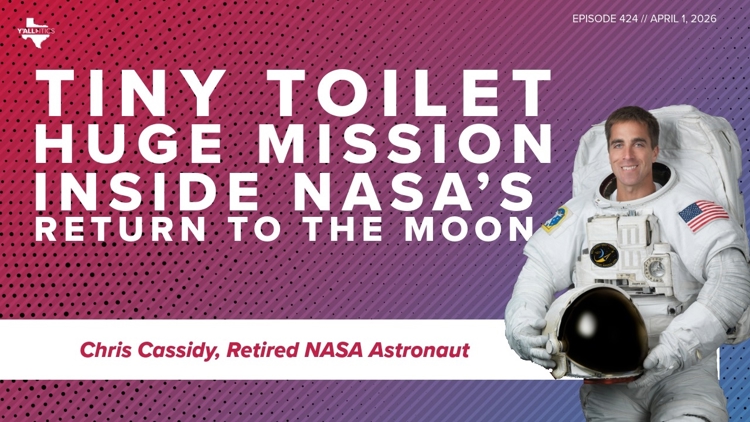
Retired NASA astronaut Chris Cassidy joins Y’all-itics to talk why the Artemis II mission is so important — and answer the most common question the public asks him.
DALLAS — It is an ambitious journey, the kind that dares folks on Earth to look up and dream: astronauts are about to travel farther from Earth and closer to the Moon than any human in more than five decades.
The Artemis II mission will take four astronauts on a 10-day mission to fly around the moon and back, NASA’s first mission with humans using the new Space Launch System (SLS) rocket and Orion spacecraft.
While this is a “lunar flyby,” the goal is to use this mission as the launching pad for putting humans on the surface of the Moon and eventually Mars.
“Space travel is one of the unique things in our world that can do something like that and pull countries together that are having odd times on the ground in normal life. But space travel transcends all that and allows people to get along and work together in harmony,” retired NASA astronaut Chris Cassidy told us on Y’all-itics. “And I think ultimately, when people are marching around on Mars, it’ll be multiple countries doing it together and that’s how we’ll be successful in that type of big endeavor. And the first step there is this week going around the moon.”
Chris Cassidy is a retired NASA astronaut with a resume that could seemingly reach the International Space Station from Earth. He’s a veteran of three space flights. Three hundred seventy-eight days total in space. 10 spacewalks. He was NASA’s Chief of the Astronaut Office, the person who assigns astronaut crews. Before that, he was already a decorated Navy SEAL who deployed four times to Afghanistan and received two Bronze Stars. And the list would go on, but we’re told the rest is classified.
Cassidy says this trip around the moon is the first in a series of steps preparing NASA and astronauts for the much more ambitious missions in the future.
“It’s very prudent to test incrementally things before you commit to something that you can’t get back from,” he said. “So, think of it like a test drive, test operation of whatever piece of machinery that is comfortable in your head to think about. That’s what we’re doing.”
The Artemis II crew is made up of National Aeronautics and Space Administration
(NASA) astronauts Reid Wiseman, Victor Glover, and Christina Koch. The four person crew is rounded out by Canadian Space Agency (CSA) astronaut Jeremy Hansen.
NASA tells us that leading up to the lunar launch, the astronauts had to follow a regimented sleep schedule and nutrition plan. That helps them maintain energy and hydration for the launch and helps to ensure they pass all of the medical checks preceding takeoff.
The mission will, among other things, focus on astronaut health… how are their bodies, minds and behavior holding up.
This isn’t the International Space Station (ISS) in low Earth orbit. That’s about 250 miles above us. The Artemis II astronauts will travel 4,600 miles beyond the moon. That’s farther than Apollo 13 reached in 1970, the previous record for the farthest humans have traveled from Earth: 248,655 miles. At that distance, NASA says from the crew’s perspective, the Moon will appear to be roughly the size of a basketball held at arm’s length, while Earth will still be visible some 250,000 miles away.
The mission will also inform how deep space travel impacts astronauts. That includes collecting and storing saliva and wearing wrist monitors that will track their sleep and movement. They’ll also investigate how the immune system reacts to spaceflight.
Astronauts also have to adjust to the Orion spacecraft itself, where space is at a premium. NASA says it’s about as big as a studio apartment. That will be home to four people for 10 days. Compare that to the ISS, which is larger than a six-bedroom house that comes complete with six sleeping quarters, two bathrooms, a gym, and a 360-degree view bay window.
Needless to say, Cassidy says privacy is hard to come by and something you have to grant to your fellow astronauts… especially when it comes to the toilet.
“Everyone’s got to eat. Everyone’s got to pee. Everyone’s got to poop,” Cassidy gingerly explained to the Jasons. “The hole in the toilet on the spacecraft is small. So, you practice and you make sure it goes in there. But every now and then you could have an escapee and that’s not something you want to deal with in a small, little capsule.”
Cassidy says the most common question astronauts get from the public is how they go to the bathroom in space.
The Artemis II mission will take the astronauts to the far side of the Moon, the side that always faces away from Earth. The crew will study geologic features on the surface, including ancient lava flows and craters.
This information is critical in helping NASA plan the next mission, Artemis III, when astronauts are scheduled to explore the lunar surface, and future missions they hope will eventually lead us to the fourth rock from the Sun.
“I believe we’ll see people walking on Mars before the three of us leave this planet,” Cassidy said confidently.


