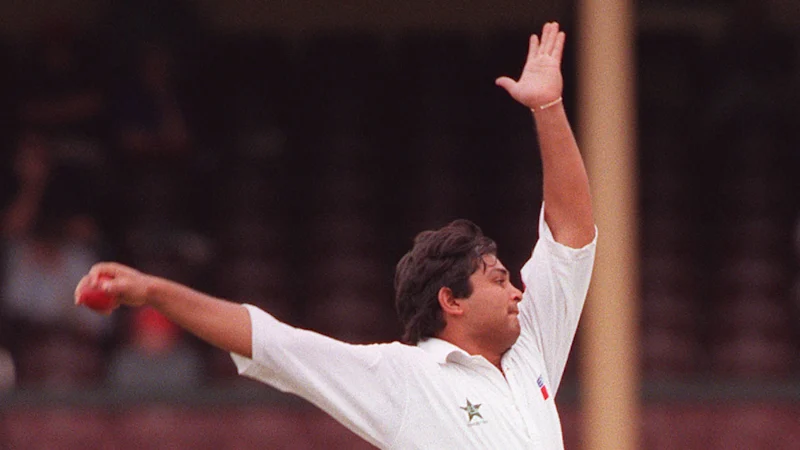

Mackay: Early on the 1993 Ashes tour, Ian Healy introduced Shane Warne to Mushtaq Ahmed, the whirling wrist spinner who was serving as Somerset’s overseas player after doing well for Pakistan the previous year.
Sitting outside a cafe in Mackay, where he is serving as Bangladesh spin coach, Mushtaq laughingly recalls how, as the more established spinner in international cricket at the time, he told Warne all he knew about bowling on slow pitches in England, changing his pace and dealing with a damp ball.
A few weeks later, Mushtaq came off the field for Somerset to see replays of what Warne had done to Mike Gatting with his first ball in an Ashes Test in England.
“I discussed those things for a good 40-minute chat,” Mushtaq tells this masthead. “Then after that when he bowled his first ball to Mike Gatting, I decided, well, actually, I am the one who needs to get some lessons from Warnie.”
Their relationship was a fruitful one as fellow leg-spinners, in what became a fine era for tweakers. A couple of years later they duelled in a series in Australia, Mushtaq claiming 18 wickets in two Tests and gaining a victory at the SCG, still Pakistan’s most recent on these shores. Warne scooped 19 in the two matches for which he was fit to bowl.
In the 2000s, they shared county games with each other as Warne, Mushtaq, Anil Kumble, Saqlain Mushtaq and Muttiah Muralitharan all spent their northern summers in England.
“We used to talk a lot, Warnie, Murali, Saqlain. When we used to play, after the game we would share knowledge, tell each other things,” Mushtaq says. “Warnie was very good on that, he used to say ‘your wrong’un is better’, and I’d say ‘your leggie is so good, man’.
“We had different strengths and weaknesses. I would ask him about the flipper, he’d ask me about the wrong’un. We’d share knowledge and tactical moves, but also be smart not to tell each other everything.
“We had a very good relationship, but we were very competitive. I never wanted to give him my wicket, but he would also try to smash me. We’d have a smile on our faces, but we were in battle all the time.”
After a prolific stint with Sussex, Mushtaq moved straight into a coaching role with England, where he mentored Graeme Swann and Monty Panesar through three consecutive Ashes wins and a rare series victory in India, where he also worked closely with Kevin Pietersen. Crucially, Mushtaq was a less intense counterpoint to then head coach Andy Flower, serving as a link between the players and their strict headmaster.
“I never coached Swanny,” Mushtaq says. “He didn’t like to be coached. We played more tactical games. We used to play against each other, and the first thing he said was, ‘I don’t like to be coached’, so I said don’t worry about it, I will never coach, but tactically you know how to get people out, what angles of bowling you have to learn.
“What pace you need to bowl in Brisbane, or in Mumbai, or Sri Lanka, which batsman needs what. Tactical field positions when the pitch is turning. Where you want to let the batsman play, all those things. So he started to trust me, and that’s when you get the best results. If any team wants to rule the world, they need to have a good spinner. He played a huge part in those three Ashes wins we had.
“Jimmy Anderson, Stuart Broad, whoever the fast bowlers are at that time, they need to have a rest, and they need to see the spinners getting one or two wickets. Maybe the spinner doesn’t get a five-for, but one or two wickets in the middle overs, when the partnerships are building and the fast bowlers are tired, that is what good spinners do.”
With Pakistan, Mushtaq aided Yasir Shah when he spun webs around England and Australia. He joined Bangladesh in 2024. Now aged 56, Mushtaq’s beard has a broad streak of white, but his eyes still twinkle with a love of cricket, spin bowling and coaching.
Bangladesh’s upset of Australia in Darwin was, Mushtaq says, a triumph for a team that has committed itself to playing “proper Test cricket” with the benefit of a strong generation of pace bowlers and spinners. He took particular satisfaction from how left-armer Taijul Islam found a way past Marnus Labuschagne in Australia’s second innings, and also how Mehidy Hasan Miraz deceived Steve Smith and Beau Webster.
“Taijul getting Marnus, a partnership was building up,” he says. “So you need your spinner to react, not to go for too many runs, but they need wickets. Always look for wickets, how you do that is about reading a situation, reading a batsman.
“Taijul’s a matchwinner for every situation now. Miraz can bat, you can see how he scored crucial runs in the first Test, and then the belief and tactical things with bowling. Both of them trust me, they buy in and try to execute the training plans.
“So for example in the second innings when the rough was there for the off-spinner, I said to Miraz, ‘how are you going to land it there?’ He was not sure. I said, ‘it will be very difficult if you bowl from close to the stumps, that angle will give you difficulty to specifically land in that area. So you have to cut down the angle and come from wide of the crease’. Little things like that can make a huge difference.”
Looking at the way Test cricket is now being played, including by his former pupils in England, Mushtaq believes Bangladesh can prosper because too many other teams and players are showing poor techniques, and a lack of patience in the era of Twenty20 and franchise leagues.
“Sometimes I think because of T20 cricket they don’t believe in skills any more, they believe in power and fitness, which is fair enough,” Mushtaq says. “I don’t deny they can play wonderful shots, but the temperament of Test cricket they haven’t got any more, [such as knowing] when to survive, when someone is bowling a good spell, how to counteract that.
“Or when a partnership is building, how to counter that. Those things are going away, and that’s why you’re hardly seeing fourth and fifth days. Because of T20 cricket, the patience level isn’t there any more. People have poor technique now, to be honest. Newcomers now, any time you see the ball is swinging or turning, they hardly have a chance to survive and score runs.
“It’s up to coaches and cricket boards to have a system where they remember the skills. And skills will always be successful with better technique. I always make sure my spinners have good alignment and a repeatable actions. Good overs will get you wickets, not good balls. If your technique is not right, you will never bowl good overs.”
While hesitant to comment specifically on Nathan Lyon’s struggles in the first Test, Mushtaq pointed to the way Tanzid Hasan played in making his century.
“It was proper Test cricket, the way Tanzid got a hundred,” he says. “At times he survived, at times he played a few shots, at times he attacked Nathan Lyon. He never let him settle down. All those things, tactically and technically, were so lovely to watch. That’s what Test cricket is all about.”
And Test cricket is what Bangladesh wants more exposure to. Mushtaq is adamant that the talent in their system now, which was a major reason for his decision to sign on with the BCB in 2024, merits more significant series of three matches or more against Australia, England and others.
“I believe we should get more Test matches now,” Mushtaq says. “We should play Australia for three matches. Why I’m saying that is we have a good bowling unit now. We beat Pakistan in Pakistan and … we won the one-day series against New Zealand and Australia recently. Bangladesh deserve more big series against big teams.
“I played my cricket with the sorts of players who could win a game from nowhere, so it became my second nature. Yes, Australia are one of the best teams and we have to respect that, but still we can beat them. That belief has to come from the heart.”
News, results and expert analysis from the weekend of sport sent every Monday. Sign up for our Sport newsletter.
 Daniel Brettig is The Age’s chief cricket writer and the author of several books on cricket.Connect via X.
From our partners
About the Author


